
Introduction
Nestled along the shores of the majestic Lake Tanganyika, Kalemie, the capital of Tanganyika province, is undergoing rapid—and often unplanned—urbanization. Long overlooked in national investment strategies, the city is now gaining renewed attention thanks to its strategic location, natural resources, and lakeside access. However, this accelerated growth poses major challenges in infrastructure, urban planning, and basic service delivery.
A Demographic Boom Over Ten Years
Kalemie’s demographic growth is striking:
In 1975, the city had approximately 25,929 inhabitants.
By 2000, the population had already reached 199,530.
In 2015, it soared to 599,951 inhabitants (source: City-Facts).
In 2025, estimates approach 800,000 inhabitants.
This population surge is placing immense pressure on housing, transportation networks, sanitation, water supply, and electricity.
A City Without a Modern Urban Plan

The last master urban plan for Kalemie dates back to the 1980s, when the city still depended on Katanga province. Since then, no updated planning document has been implemented to guide the city’s spatial development. Without regulatory zoning or clear guidelines, Kalemie is expanding chaotically, with an increasing number of informal settlements.
Roads and Mobility: A Severely Inadequate Network
The condition of the road network is one of the main barriers to Kalemie’s economic and social development:
Less than 20% of urban roads are paved.
Secondary roads, often dirt paths, become impassable during the rainy season.
The lack of a structured road network hinders access to peripheral areas and limits urban mobility.
Housing and Informal Settlements
With unregulated urban growth, more than half of Kalemie’s residents live in unplanned neighborhoods, built without land titles or connections to essential utilities. Land access remains difficult and a frequent source of conflict, while social housing policies are virtually non-existent.
Water, Electricity, and Sanitation: Services in Crisis

Drinking Water: Despite its location on Lake Tanganyika, access to clean water remains limited. REGIDESO’s aging infrastructure serves only 30 to 40% of the population.
Electricity: Power supply is unstable and unreliable. Frequent blackouts push residents to rely on generators or individual solar panels.
Sanitation: There is no structured wastewater disposal system. Drains are rare and often clogged, and rudimentary latrines pose serious health risks.
The Port of Kalemie: An Underutilized Strategic Asset
Located on Lake Tanganyika, the port of Kalemie is the largest on the Congolese shore:
It handles about 60,000 tons of imports annually and 2,400 tons of exports (mainly coltan).
Its historical export capacity of 1,500 tons/year is expected to increase to 15,000 tons/year thanks to modernization works.
The quay is 360 meters long, but only part is operational, with 2 of 6 cranes in use.
The port also suffers from silting, preventing large vessels from docking.
New Investments: Signs of Hope
Despite the challenges, several recent public and private investments offer hope:
USD 127 million has been mobilized through a public-private partnership (PPP) with Chinese company CGGC to modernize the port (contract signed in April 2021).
Construction of the Joseph Kabila stadium, inaugurated between 2016 and 2021.
The 2024 inauguration of an autonomous agency of the Central Bank of Congo in Kalemie.
A dry port project covering over 60 hectares is under discussion with Tanzania to strengthen bilateral logistics capabilities.

Kalemie and ExpoBeton: A Laboratory for Urban Reconstruction
Kalemie today serves as a case study for post-conflict urban reconstruction. By focusing on locally adapted materials (local concrete, ecological sanitation solutions), resilient infrastructure, and sustainable planning, the city could become a model for other provincial capitals in the DRC.
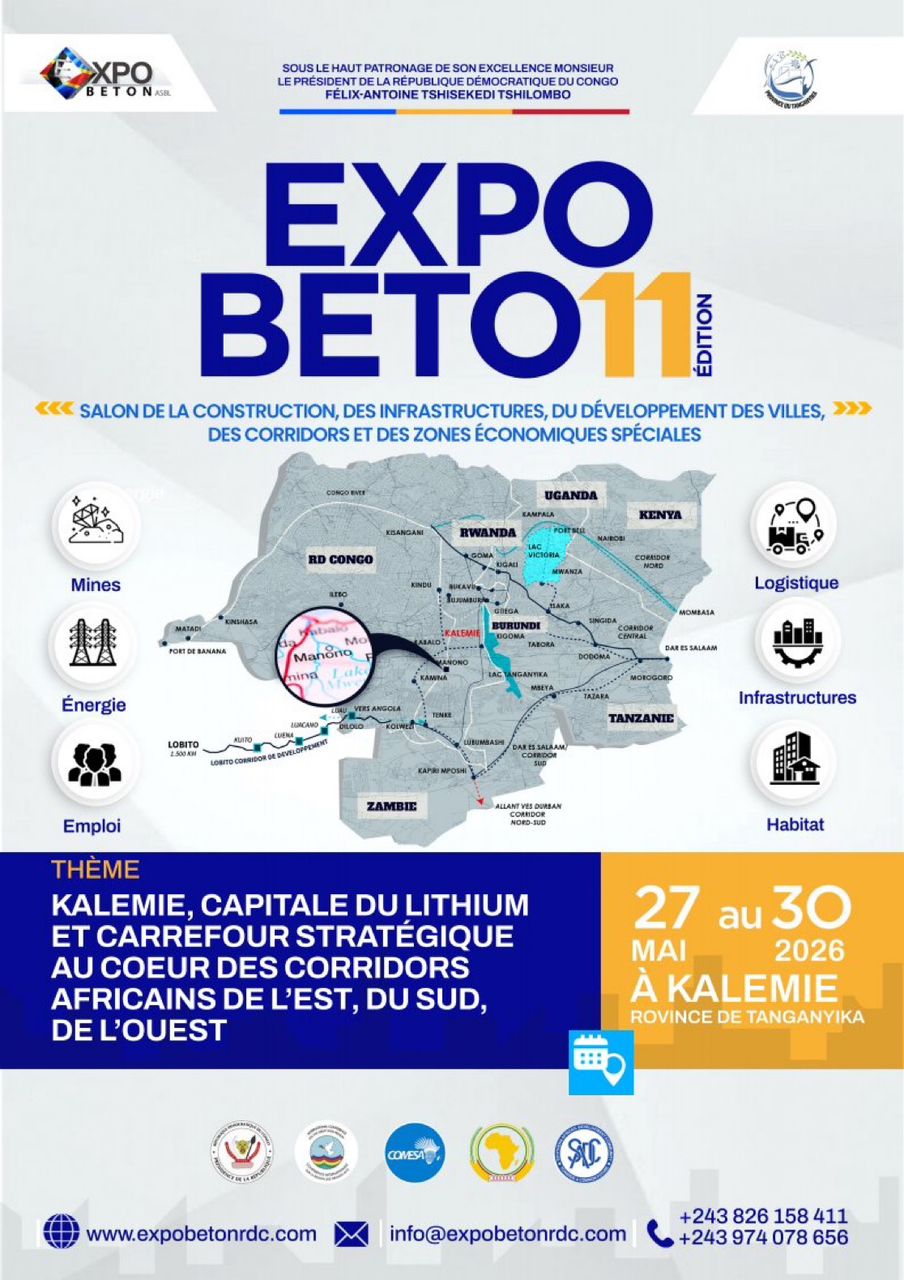
ExpoBeton plays a key role as an accelerator, connecting local needs to technical and industrial innovations in the construction sector.